

CNC & METAL FABRICATION CASE STUDY
Aluminum Frame Fabrication Optimized for Cost and Production Volume
This aluminum frame fabrication project started with a costly manufacturing route: the complete frame was CNC machined from solid 6061-T6 aluminum. At a required volume of 1,000 pieces per month, SPM reviewed the design and replaced the single-process strategy with a combination of tube bending, CNC machining, welding and powder coating.
The goal was not simply to find a cheaper process. The redesigned manufacturing route still had to meet the required structural performance, preserve the functional geometry and remain practical for repeat production. By matching each feature to the most suitable process, the unit cost was reduced from US$16.50 to US$7.00.
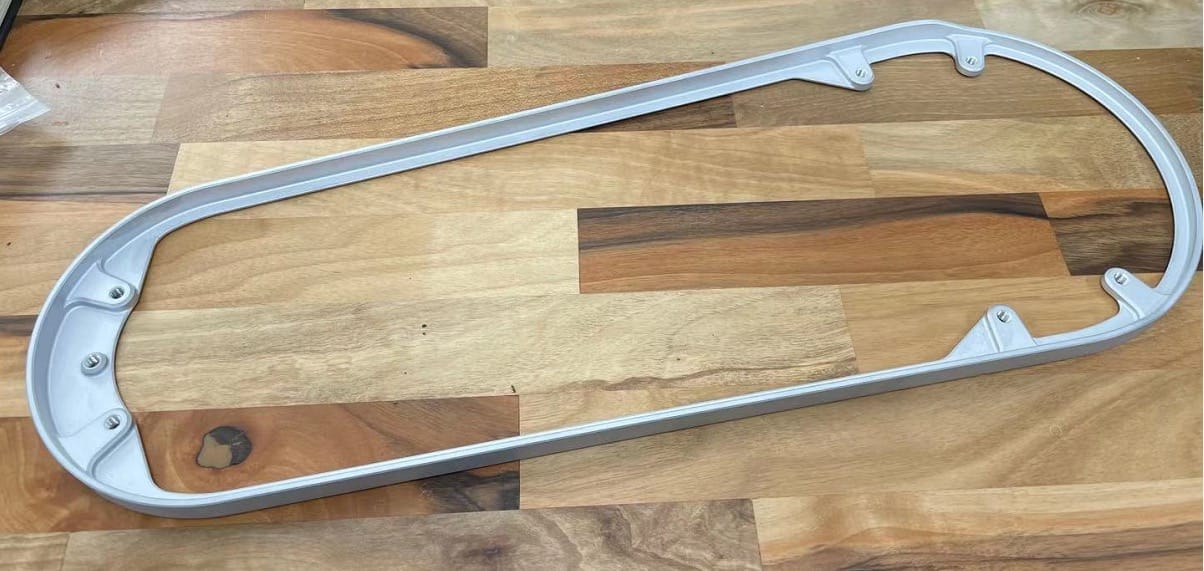
Finished 6061-T6 aluminum frame produced using the optimized hybrid manufacturing route.
MANUFACTURING CHALLENGE
Why the Original Aluminum Frame Was Too Expensive to Produce
The original design relied on single-piece CNC machining from solid aluminum stock. Although technically straightforward, this created a poor cost structure for repeat production. A large proportion of the starting material had to be removed as chips, while machining time was spent creating geometry that could be produced much more efficiently by forming.
For low-volume production, that aluminum frame fabrication approach may sometimes be acceptable. At 1,000 parts per month, however, material utilization and machine time become major cost drivers. The challenge was therefore to redesign the aluminum frame fabrication route without compromising the strength required by the application.
Single-Piece CNC Machining
- The complete frame was machined from solid aluminum stock.
- A significant amount of material was removed during machining.
- Long machining time increased machine-hour cost.
- The process used an expensive method for relatively simple curved sections.
- The approach became increasingly inefficient as production volume increased.
Design & Process Integration
- Tube bending created the main curved frame geometry.
- CNC machining was reserved for features requiring precision.
- Welding joined the fabricated elements into the final structure.
- Powder coating provided the required finished appearance and surface protection.
- The process was designed around repeat production rather than prototype manufacturing.
Key decision: cost reduction came from changing the complete manufacturing strategy, not from negotiating a lower CNC machining rate for the original design.
PROCESS OPTIMIZATION
Turning a CNC-Machined Part into a Hybrid Aluminum Frame Fabrication Process
The optimized aluminum frame fabrication solution separated the frame into manufacturing features and assigned each feature to the process that could create it most efficiently. This is a fundamental difference between simply quoting an existing drawing and applying design-for-manufacturing thinking before quotation.
The primary frame profile was formed from aluminum tube instead of being machined from a solid plate or billet.
Machining was retained where dimensional accuracy, holes or local interface geometry required it.
The formed and machined elements were joined into the required structural assembly.
The finished frame received a consistent protective and decorative surface treatment.
This approach reduced dependence on CNC machining without eliminating machining where it provided real value. The result was a more balanced aluminum frame fabrication process with substantially better material utilization and a production route better suited to monthly repeat orders.
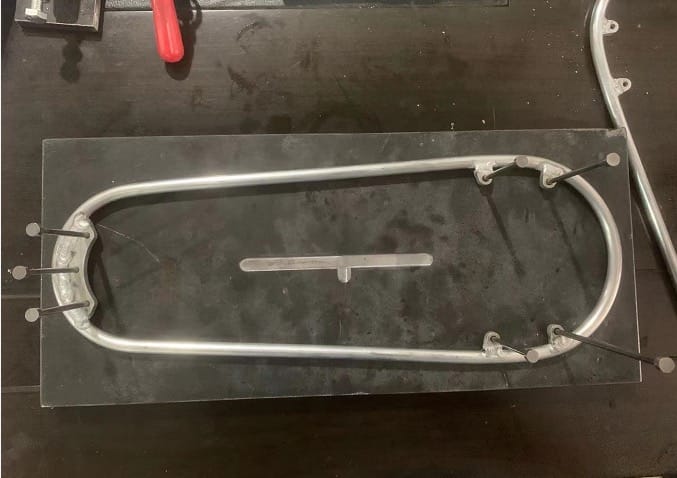
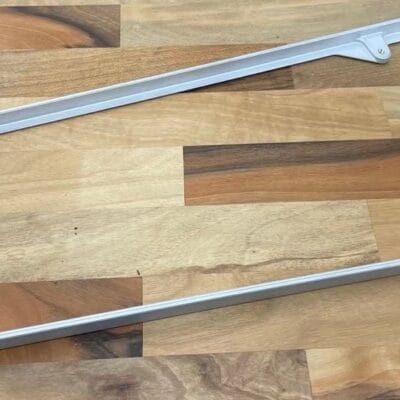
Production-stage aluminum frame showing the fabricated structure and assembly fixture.
MATERIAL & PROCESS SELECTION
Why 6061-T6 Remained Suitable for the Optimized Design
The cost reduction did not require replacing the specified aluminum with a lower-grade material. Instead, the engineering work focused on using the existing material more efficiently.
6061 belongs to the 6xxx aluminum alloy family. For general technical background on this alloy series and aluminum product standards, see The Aluminum Association’s standards resource .
The important manufacturing question was therefore not simply “Which material is cheapest?” but “How can the required material and strength be converted into the finished geometry with less waste and less machining?” For this project, bending and fabrication provided a more economical route than removing a large quantity of material from solid stock.
Die casting was also evaluated but was not selected because it could not satisfy the required strength for this application. The final aluminum frame fabrication strategy therefore retained 6061-T6 while changing how the geometry was produced.
COST REDUCTION
57.6% Lower Unit Cost Through Process Optimization
Once the optimized process was established, the financial impact became significant because the production requirement was 1,000 parts each month. The unit cost decreased from US$16.50 to US$7.00, a reduction of 57.6%.
| Cost Level | Before | After | Change |
|---|---|---|---|
| Cost per part | US$16.50 | US$7.00 | −57.6% |
| 1,000 pcs / month | US$16,500 | US$7,000 | −57.6% |
| 12,000 pcs / year | US$198,000 | US$84,000 | −57.6% |
The saving came primarily from reducing unnecessary machining and material removal. This is why cost optimization becomes increasingly valuable as annual production volume grows: a relatively small saving per part is multiplied across every production batch.
DESIGN FOR MANUFACTURING
Why Process Selection Matters in Aluminum Frame Fabrication
A drawing defines the required finished component, but it does not always define the most economical way to manufacture it. Two suppliers can quote the same geometry using completely different production strategies, with very different material usage, cycle time, tooling cost and unit price.
For this reason, SPM evaluates whether every feature actually needs CNC machining. Curved structural geometry may be better suited to tube bending. Local precision features may still require CNC machining. Separate sections may be more economical to weld, while powder coating can be applied after fabrication as the final finishing operation.
Effective aluminum frame fabrication therefore depends on designing the manufacturing route as a complete system. Optimizing only one individual process may reduce one cost item while leaving the largest source of waste unchanged.
Engineering takeaway: the lowest-cost manufacturing route is not necessarily the cheapest individual process. The greatest savings often come from combining several processes so that each one performs only the work it is best suited to do.
WHEN PROCESS OPTIMIZATION MAKES SENSE
When Should a CNC-Machined Aluminum Frame Be Redesigned for Fabrication?
Replacing a fully CNC-machined frame with an optimized aluminum frame fabrication structure is not automatically the right choice for every project. The potential benefit depends on production volume, geometry, tolerance requirements, structural loads and the amount of material removed by the original machining process. The greatest opportunity usually appears when a part contains large curved or structural sections that consume substantial stock and machine time but do not require CNC-level precision across every surface.
Production volume is another important factor. For prototypes and very small batches, machining a complete frame from solid material may remain practical because it avoids additional fixtures, welding development and process coordination. As monthly or annual demand increases, however, recurring material waste and machining hours can become much more expensive than the one-time engineering effort required to establish a more efficient aluminum frame fabrication route.
When Aluminum Frame Fabrication Can Reduce Cost
- Production quantities are high enough for recurring unit-cost savings to justify process development.
- Large sections of the component can be formed from tube, profile or other standard aluminum stock.
- CNC machining is required only on selected interfaces, holes or precision features.
- The original process removes a significant percentage of the starting material.
- Welded construction can meet the required structural and dimensional performance.
When Full Machining May Still Be Better
- Production quantity is low and minimizing setup or tooling investment is more important than unit cost.
- The component contains complex integrated geometry that would require too many fabricated sections.
- Critical tolerances extend across most of the frame rather than a limited number of interfaces.
- Weld distortion or joint locations could interfere with functional requirements.
- The application requires a continuous machined structure that cannot be practically reproduced through forming and joining.
SPM’s approach: process optimization starts by identifying which features genuinely require precision machining and which can be produced more efficiently by forming, fabrication or joining. The objective is not to eliminate CNC machining, but to use it only where its accuracy and flexibility create measurable value.
For this aluminum frame fabrication project, the production quantity of 1,000 pieces per month made that evaluation especially important. Tube bending could efficiently generate the main profile, while CNC machining remained available for local precision features and welding completed the structural assembly. This combination reduced cost without changing the project into a lower-performance product.
WHY THIS MATTERS FOR YOUR RFQ
Cost Reduction Starts Before the Final Quotation
For repeat-production aluminum frame fabrication RFQs, SPM’s quotation review can include more than material pricing and machine time. For suitable projects, the engineering team can also evaluate whether the original manufacturing concept is appropriate for the expected quantity.
This is particularly valuable when an existing part was originally designed for prototyping or low-volume production and later moves into higher quantities. A manufacturing route that made sense for 20 pieces may become unnecessarily expensive at 1,000 pieces per month.
In this case, redesigning the aluminum frame fabrication process reduced the annual manufacturing cost from approximately US$198,000 to US$84,000 while maintaining the required structural performance.
See more examples in our manufacturing case studies .
FOR YOUR PROJECT
Need to Reduce the Cost of an Aluminum Frame or Fabricated Part?
Send SPM your drawing, material requirement, annual quantity and current manufacturing concerns. Our engineering team can review tube bending, CNC machining, welding, finishing and alternative production routes before quotation.