

INJECTION MOLD CASE STUDY
Automatic Unscrewing Injection Mold for a Four-Cavity Threaded Component
This automatic unscrewing injection mold project involved the development of a four-cavity mold for a threaded plastic component. The tooling concept integrated automatic thread release directly into the mold so that the molded parts could be ejected without manual unscrewing or an additional secondary thread-release operation.
SPM supported the project from DFM review and mold-layout planning through mold fabrication, assembly, tryout, troubleshooting, first-article inspection and production handover. The main engineering objective was to combine reliable thread release with stable four-cavity molding, consistent dimensions and a practical production cycle suitable for repeat manufacturing.
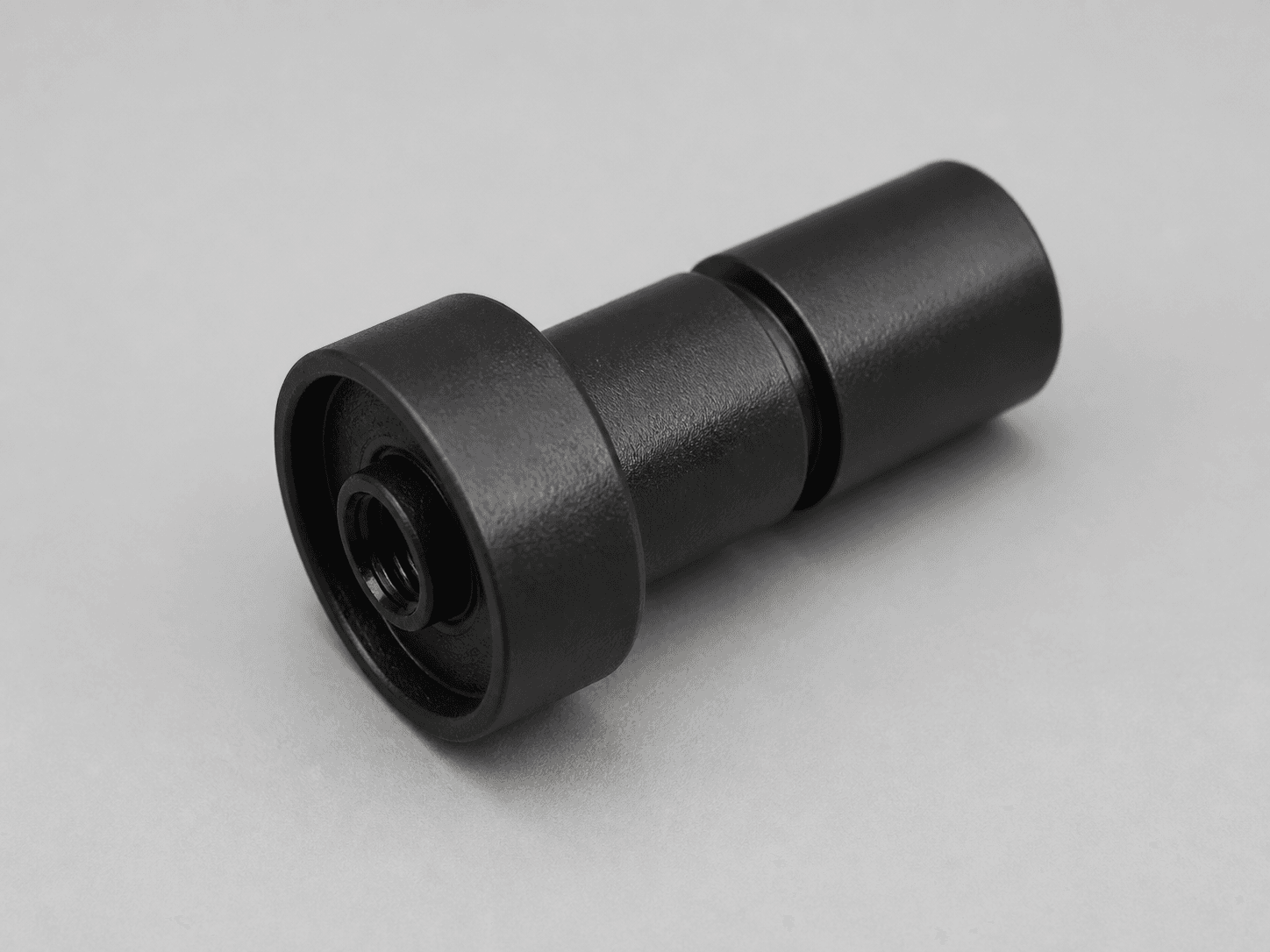
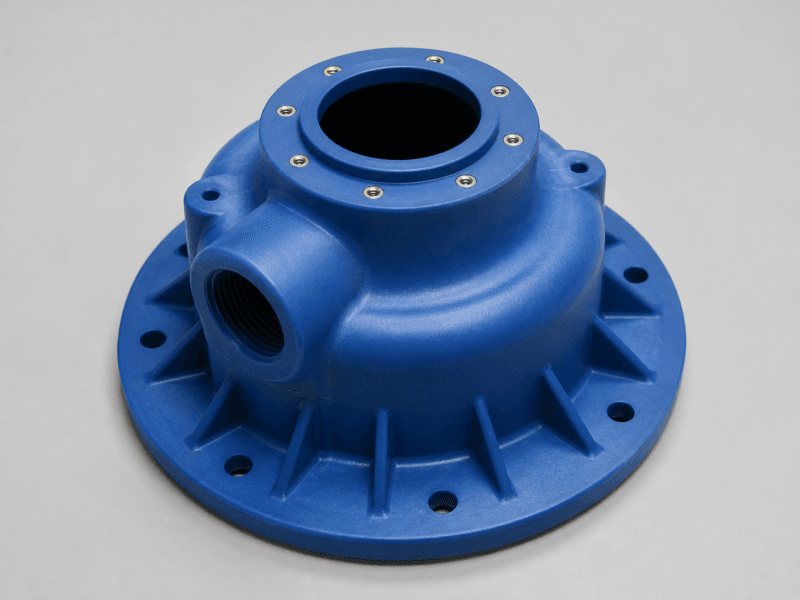
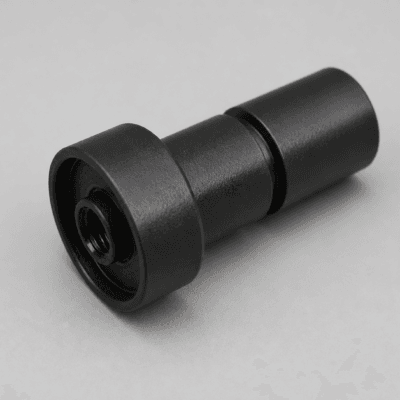
Finished threaded injection-molded component from the original project.
ENGINEERING CHALLENGE
Why Threaded Multi-Cavity Parts Require Careful Mold Engineering
A molded internal or external thread cannot always be released with a conventional straight-pull core. When the thread geometry mechanically locks the molded component onto the core, the tooling must provide a controlled method of rotation or core withdrawal before normal ejection can take place.
That challenge becomes more demanding in a four-cavity tool. The release mechanism must operate predictably across every cavity, while the molding process must still maintain balanced filling, acceptable cooling and repeatable part dimensions. If one cavity releases differently from the others, the result can be damaged threads, inconsistent cycle times or premature wear in the tooling mechanism.
For this automatic unscrewing injection mold project, the engineering review considered the threaded feature as part of the complete production system rather than as an isolated geometry. The mold layout, rotating mechanism, cavity arrangement, ejection sequence and inspection plan all had to support the same manufacturing objective.
Engineering principle: an automatic thread-release system should not be added after the mold layout is already fixed. It needs to be considered during the earliest DFM and tooling-concept stage because it influences mold architecture, available space, drive components, maintenance access and production reliability.
DESIGN FOR MANUFACTURING
DFM for an Automatic Unscrewing Injection Mold
Threaded plastic parts require more planning than a conventional straight-pull injection molded component. The mold designer must consider thread geometry, release direction, cavity layout, drive mechanism, cooling, material shrinkage and dimensional inspection as one connected system.
For this four-cavity automatic unscrewing injection mold, the release mechanism also had to operate consistently across multiple parts during every molding cycle. Uneven release timing, excessive torque or insufficient mechanical guidance could affect cycle stability, part quality and long-term tooling reliability.
Automatic Unscrewing Mold Manufacturing Requirements
- Four cavities designed for repeatable multi-cavity production.
- Threaded features released automatically instead of using manual secondary operations.
- Mold structure designed to support stable and synchronized thread release.
- Core and cavity geometry planned with material shrinkage and part release in mind.
- Dimensional control considered during mold design rather than after tooling completion.
- Production repeatability evaluated during mold tryout and first-article inspection.
Engineering Scope
- DFM review and evaluation of threaded part geometry.
- Parting-line, core and cavity planning.
- Automatic-unscrewing mechanism development.
- Four-cavity mold-layout design.
- Mold component fabrication and assembly.
- Tool tryout and troubleshooting.
- First-article dimensional inspection.
- Production process handover.
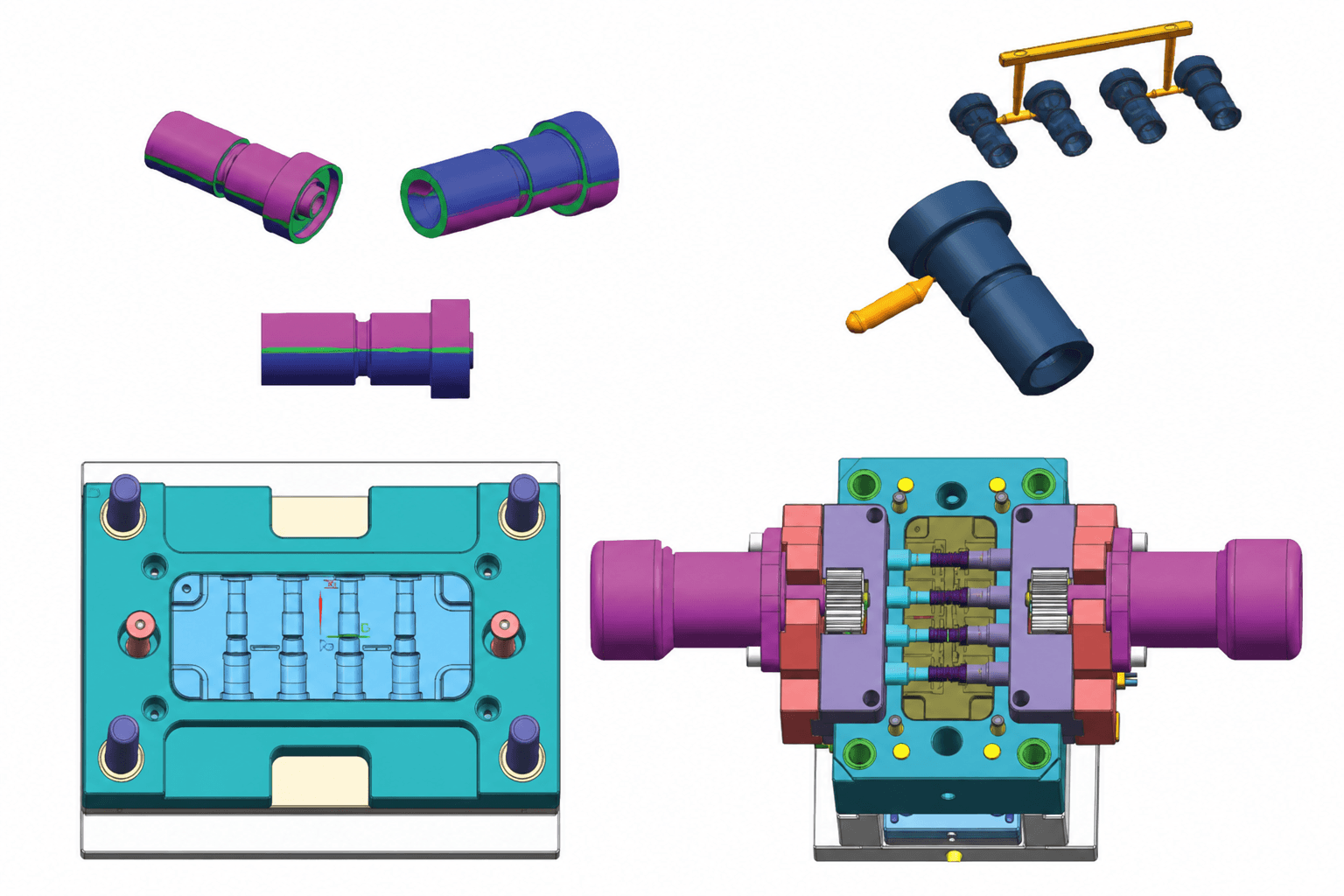
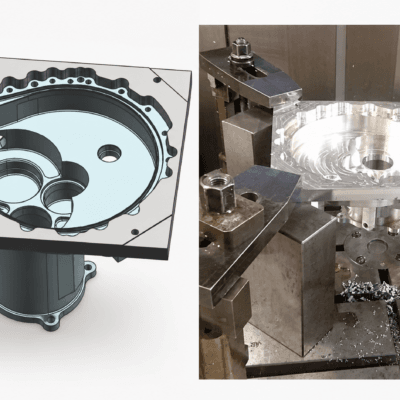
Original CAD material showing the threaded component, cavity layout and automatic-unscrewing mold concept.
TOOLING STRATEGY
Designing the Unscrewing Mechanism for Repeat Production
An automatic thread-release concept has to do more than successfully remove one molded sample during the first trial. It must repeat the same mechanical sequence over many production cycles without creating excessive wear, unstable timing or unnecessary maintenance.
The automatic unscrewing injection mold tooling strategy therefore needs to consider how the rotating core is driven, how motion is guided and synchronized, how the mechanism is supported inside the mold, and how easily wear components can be inspected or replaced. These practical details often determine whether an automatic unscrewing injection mold remains reliable after the initial validation stage.
Another consideration is the relationship between the mold cycle and the mechanical unscrewing time. The release sequence should be engineered so that automation provides a genuine production benefit rather than creating a new bottleneck. For repeating orders, this becomes increasingly important because even small differences in cycle stability can have a significant effect on annual output.
MOLD BUILD & TRYOUT
Automatic Unscrewing Mold Fabrication and Tryout
After the automatic unscrewing injection mold concept was confirmed, the project moved into mold manufacturing, assembly and tryout. The mold-build stage focused not only on machining the core and cavity components, but also on ensuring that the mechanical unscrewing system could operate smoothly under repeated production conditions.
During mold tryout, the engineering team checked thread release, cavity filling, molded-part appearance and dimensional consistency. Troubleshooting at this stage is especially important because the molding process and mechanical release system must work together. A mold that fills correctly but cannot release the threaded feature consistently is not ready for stable production.
Trial results also provide feedback for process settings such as injection parameters, cooling time and the timing of the release sequence. The objective is not merely to produce an acceptable first sample, but to establish a repeatable operating window that can later be transferred to normal production.
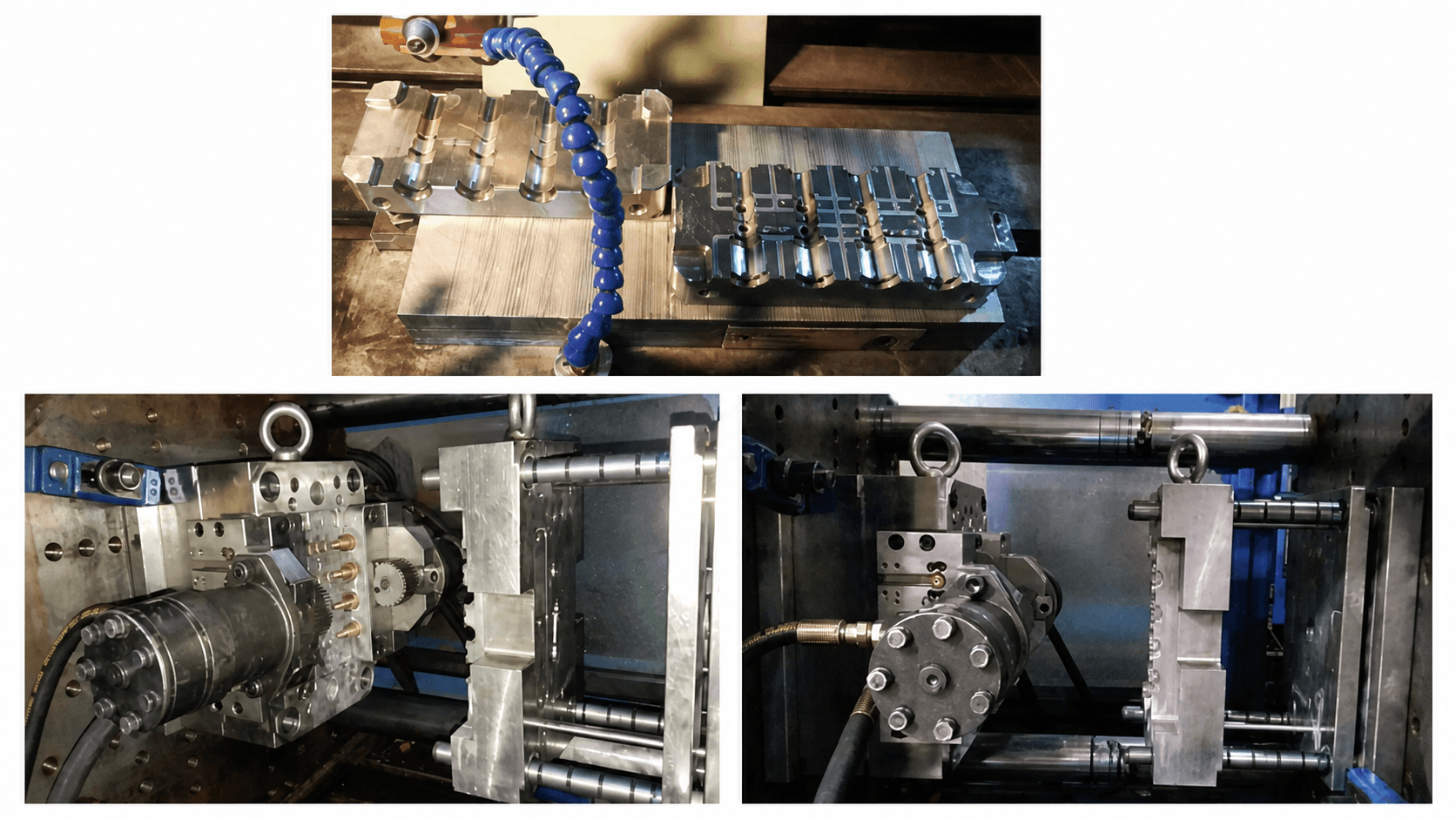
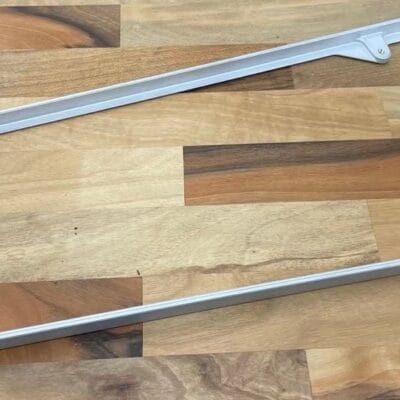
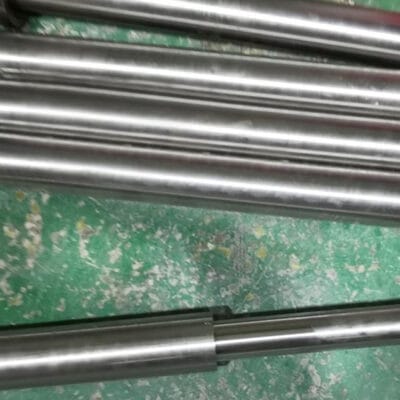
Workshop images from the original case showing mold fabrication and trial-stage equipment.
Why this approach matters: threaded injection-molded components require the release mechanism, cavity balance, molding parameters and inspection plan to work together. Addressing these factors during tooling development reduces the risk of unstable production, damaged threads or unnecessary manual operations after molding.
QUALITY VALIDATION
Dimensional Validation Before Production Handover
The automatic unscrewing injection mold project included first-article dimensional inspection before production approval. This step verified that the molded threaded component met the required dimensional criteria and that the automatic thread-release process did not introduce unacceptable variation between cavities.
For multi-cavity molds, validation should consider both individual part dimensions and cavity-to-cavity consistency. A single conforming sample does not necessarily demonstrate that the entire tool is stable. Multiple cavities therefore need to be evaluated as part of the production system.
The validation stage also provides an opportunity to identify whether dimensional variation originates from the molded-part design, process settings, cavity conditions or mechanical thread-release sequence. Resolving those issues before production handover reduces the likelihood of repeating the same troubleshooting after the mold enters regular service.
For additional background on injection molding design and manufacturability, see the Autodesk injection molding resource .
PRODUCTION BENEFITS
Why Automatic Unscrewing Can Improve Repeating Production
With an automatic unscrewing injection mold, integrating the thread-release function into the tooling eliminates the need for an operator to manually unscrew the molded component or perform a separate release operation after molding. For suitable production volumes, this can reduce operator dependence and create a more consistent manufacturing sequence.
The four-cavity configuration also increases the number of components produced during each molding cycle compared with a single-cavity tool. When the cavity system and thread-release mechanism are designed as one coordinated process, the result can support both higher output and more repeatable part quality.
Automation can also improve process control. Manual handling introduces variation between operators and shifts, while a mechanically controlled release sequence follows the same defined motion on every cycle. This is particularly relevant when the molded thread is a functional interface and damage during manual release would create scrap or downstream assembly problems.
APPLICATION GUIDANCE
When Is an Automatic Unscrewing Injection Mold the Right Choice?
An automatic unscrewing injection mold is not necessarily the best solution for every threaded plastic part. The decision should consider production quantity, thread geometry, material, allowable tooling complexity, target cycle time and the expected production life of the program.
For prototype quantities or very low-volume production, a simpler tooling concept or secondary operation may sometimes be more economical. For repeating production, however, the higher initial complexity of an automatic unscrewing injection mold can be justified when it removes manual operations, improves consistency or supports a multi-cavity production strategy.
This is why SPM evaluates the complete manufacturing requirement before quotation. The objective is not simply to propose the most complex mold, but to identify a tooling concept that matches the customer’s annual demand, quality requirements and expected production economics.
See more examples in our manufacturing case studies or contact our team to discuss a new tooling project.
FOR YOUR PROJECT
Need an Automatic Unscrewing Injection Mold?
Send us your part drawing, material requirement and expected annual volume. Our engineering team can review thread geometry, cavity strategy, mold structure and automatic thread-release feasibility before quotation.